
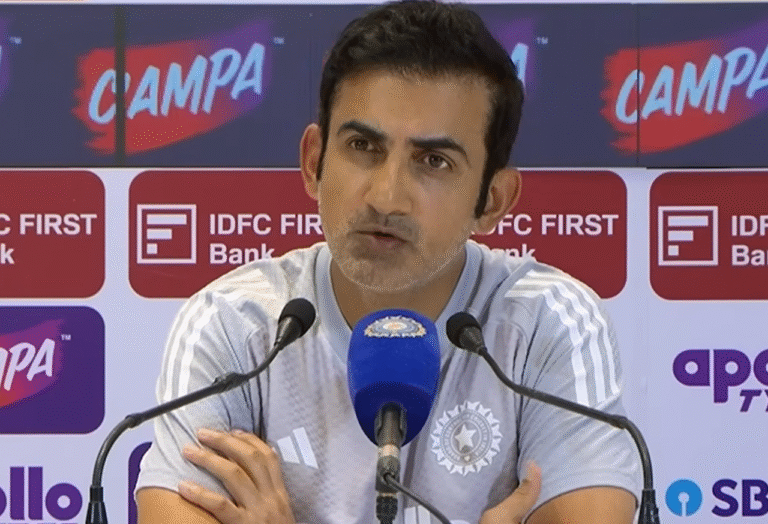
Gambhir on India’s Transition, India Faces Crucial Test.
During a press conference following the humiliating defeat of India at the hands of South Africa, team head coach Gautam Gambhir presented the problems that were been experienced by the team in Test cricket especially during their transitional phase. The 408-run loss of India against South Africa at the Guwahati venue was their first impressive loss at home in under a year, after a 3-0 loss to New Zealand in 2024. Since July 2024 under the leadership of Gambhir India has faced unforeseen hiccups particularly in the Test format and now there is a query of the future of the team.
When Gambhir was questioned on his status as head coach, he was straight to the point and said that it is up to the Board of Control for Cricket in India (BCCI) to decide upon his tenure as head coach. He once again said that it was his obligation to Indian cricket that comes first and his position second; later the team needs to be victorious and individual achievements are of hardly any value. Gambhir’s main point to the media was that even though his side had experienced some losses in the recent past, his leadership had brought about some significant successes including the attracting of a Test series in England and the victory of both the champions trophy and Asia Cup in the previous year.
The current change process is especially noticeable in the domain of batting and bowling as the team is currently adapting to the retirement of such a giant as Virat Kohli, Rohit Sharma, and R. Ashwin. Another young talent, Shubman Gill, has assumed the role of captain, and there are a number of other players, particularly in the batting line, who are yet to receive the valuable experience. Gambhir pointed out that the present team is the hugely different one that was against New Zealand last year. The fact that several of the existing batters have only completed less than 15 Tests made Gambhir recommend more time to the maturity of the squad.
That is what transition is, Gambhir said and the team was deficient in experience. He mentioned that India has been playing badly in home series in recent times but it should be noted that they are regaining and need not be taken directly as compared to the former winning teams. His message is simple: the young players should be given time to learn because they now are learning in the field, and it would most surely prove difficult to test them in Cricket with top-quality teams such as South Africa.
The loss to South Africa came especially offensively to India, as the team could not make use of a dominant stand on day three. Upon 95 to 1, the batting of India broke down as 6 wickets fell on only 27 runs. The chief architect of this collapse was fast bowler Marco Jansen who claimed four of the wickets in a match changing spell. Gambhir was also not pleased with this stage of the play referring to it as not acceptable, and pointing how the team might have been on the winning side had they not collapsed.
Another issue that Gambhir touched upon was individual responsibility, particularly such that is exhibited by the aggressive firing of Rishabh Pant as a part of the collapse. Nevertheless, Gambhir did not opt to blame any individual player, but emphasized on the value of responsibility and how a player should take care of the team. Gambhir argues that the reason behind such collapses should be avoided by ensuring that players focus on the team and not on personal ambition as he thinks has not been the case with some of the performances.
In the future, Gambhir is hopeful that the transition of India will produce results although it will take a joint effort. The team needs to place priority on the Test cricket and develop an organizational culture that is concerned about long term success of the format, including the players and the support staff members. Gambhir emphasized that faulting the failure of people in the Test cricket would not serve the interest of India particularly in the context of such a major transition.
Speaking on spin department, India has apparently not been able to keep pace with South Africa in respect to Simon Harmer, Gambhir was resolute in his opinion of the existing selection of spinners, especially Washington Sundar. He observed that Sundar has just played 17 Tests, he is still an apprentice, and to expect Sundar to perform at the same level as Ashwin after a few matches would be wrong. Gambhir has once again made it clear that the incumbents will require time and the players must be given time as they acquire the experience needed to be able to fulfill in the highest levels of the game.
Finally, the plight of India under the stewardship of Gambhir is not an isolated period of transition, and the team is currently on a reformation process of its batting and bowling sectors. The defeats against New Zealand and South Africa may be recent defeats that have not gone down in a very well doing manner, but the message given by the coach of the team is optimistic because India has young players who have talent and potential to succeed but they need time and space to develop. This, as Gambhir himself has said, is precisely what transition is and it is evident in the fact that the future of the team is based on patience, perseverance and unity.
Follow us on Zeroto30s social channels:
Instagram: https://www.instagram.com/zeroto30s/
Facebook: https://www.facebook.com/zeroto30s
Twitter: https://twitter.com/zeroto30s
Youtube: https://www.youtube.com/@Zeroto30s