
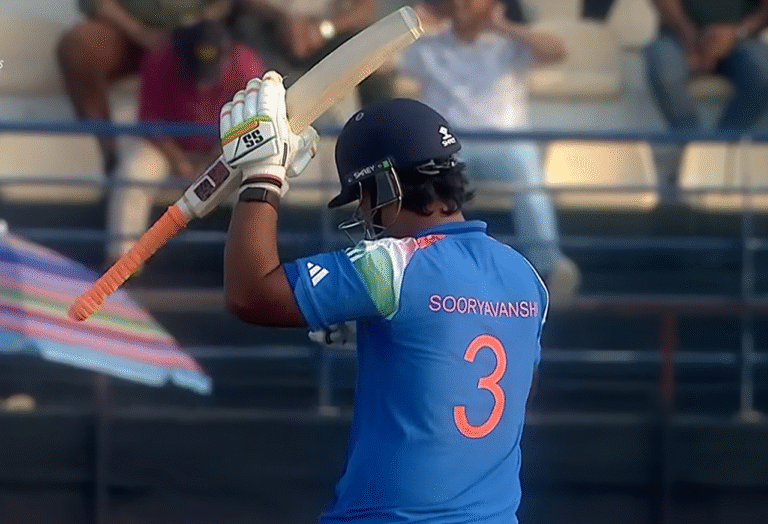
Sooryavanshi 175 will go down history as the match that made a generation, completed an undefeated campaign and led India to a record sixth Under-19 world cup. A teenager, a 14-year-old phenomenon, struck one of the greatest shocks in youth history in a match that a final is reached in the decisive stage the hunt was long over in Harare on a sun-baked afternoon when India defeated England by 100 runs.
The scorecard narrates some of the narrative: India had made 411 out of 9 the largest total in a Youth ODI by a Full Member nation. But the greater reality is, how that totality was constructed, by whom it was constructed. Sooryavanshi 175 off 80 balls was by no means only an exercise of strength, but an art-masterclass of batting with the contemporary white-ball of terrifying purpose combined with astonishing precision of attack.
Firstly, the final was already determined in nearly no time. England early struck, and Aaron George had been removed at a cheap rate, in the hope that nerves might be a factor on the greatest stage. They instead ran right down into the storm. Sooryavanshi was not going to lose any time in establishing dominance and brought down the new-ball bowlers of England with that variety of drives, extending to the most classical, to the most daring and the most outrageous. The 142-run second-wicket partnership with captain Ayush Mhatre that did not require many 15 overs left England without faith before the match had even actually sunk in.
The supporting role was an ideal one by Mhatre, taking the pressure in the initial stages and rotating strike, which left Sooryavanshi to call terms. Mhatre, falling to compose 53, gave a gaping England a slight opening. But that hope was short lived. Sooryavanshi found it easy to change gears with Vedant Trivedi and provided a 78-run boost at the third wicket as India passed 250 within 26 overs. By then it was not mad to predict a figure of 450 or even 500.
But cricket has a means of restoring the balance. India soon lost the initiative once Sooryavanshi had finally left at 175 with the pushing of the boundary of what was considered possible at the Under-19 level. His scoring rate could not be compared by anybody but more importantly, they did not collapse. The decelerated pace of the 40 by Abhigyan Kundu and the tardy push by Kanishk Chouhan never allowed the tension to cut down. The bowlers in England who were already guilty of inconsistency were overburdened by fatigue and India even went beyond 400 mark which was a psychological blow to the contest making it almost unprofitable to the male Indians.
It would have required something extraordinary to pursue 412. England must have had an ideal power play, but the bowlers of India presented 2 maidens on the first ball, kicking the much needed rate into an uncomfortable zone. RS Ambrish made a first move, and upon Ben Mayes a momentary retaliation with a volley of limits, the asking rate was steadily rising dangerously.
Ben Dawkins and the captain Thomas Rew tried to hold England in their hands and for a short time, the battle was sparked off. Dawkins had scored 50 in 50, Rew was a blast of 31 of 18, but the fact that both were dismissed so swiftly sparked a crashing down. The spinners of India increased the noose and ranged with different feet and degrees and before one could guess England had lost four wickets in nine balls.
Nevertheless, one of the sources of resistance that England had was Caleb Falconer. His 63 ball hundred was a remarkable performance in impossible conditions, whether through neat hitting, or by handsome courage of calmness. Falconer together with James Minto contributed 92 runs, which gave England some hope though not very much respectability. But the figures were inexcusable. The price demanded must have been more than ten an over, and the field had to be sprayed only brought to notice how much England had fallen behind the game.
At last, the result said everything, Falconer having been forcibly thrown out as the last wicket to fall. India had engaged England at all departments, tactical and technical. It was an equal partnership, Ambrish and Chouhan in the forefront, the fielding was keeping the standards high to which the Indian youth system has been identified.
It was not just one match in this victory. It was the first step that India did since they lost the last final to Australia and this strengthened their position as the most successful country in U-19 world cup history. In the very centre of it all was Sooryavanshi 175, an innings that was less junior than international cricket, and which had the added taste of a preview of what the future of international game might bring.
To the fans, the selectors and young cricketers who are watching all over the world, it is obvious that a new star has come into being. And in the case of India, the manufacturing facility that has sustained the old team is as robust as ever.
Instagram: https://www.instagram.com/zeroto30s/
Facebook: https://www.facebook.com/zeroto30s
Twitter: https://twitter.com/zeroto30s
Youtube: https://www.youtube.com/@Zeroto30s